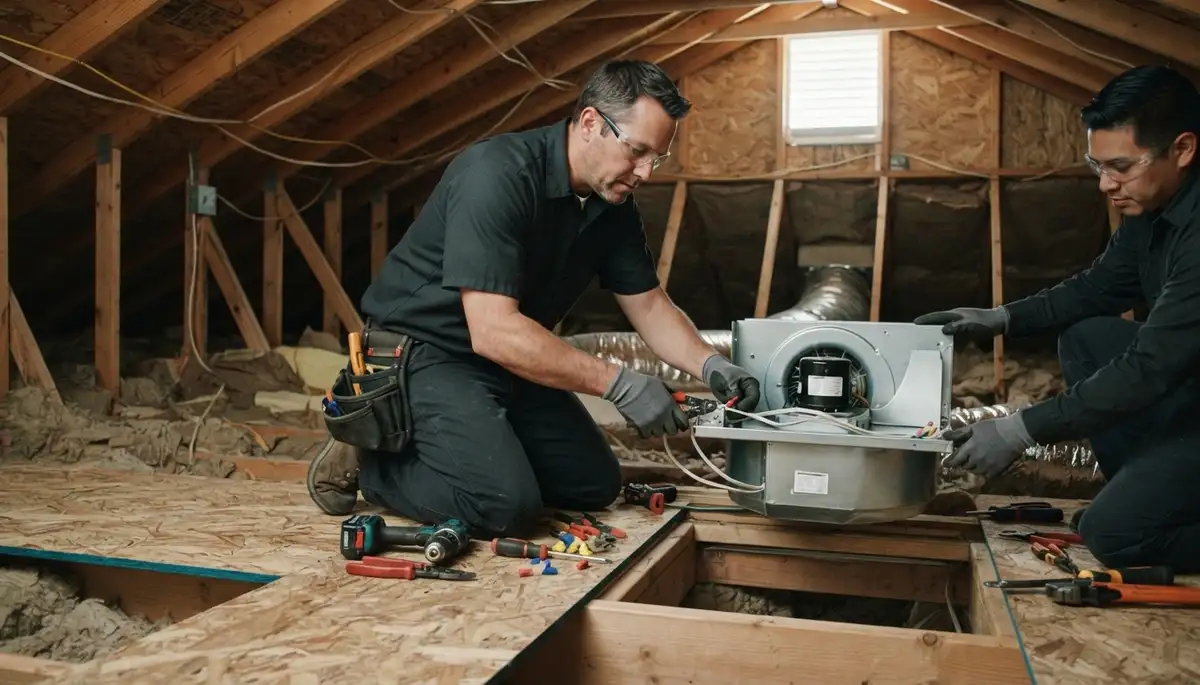
Whole House Fan Work Boston Homeowners Can Count On
Whole House Fan installation in Boston starts with the house itself. Most homes here went up between the early 1900s and the 1960s, and those decades of wood-frame and attached row construction set the conditions every job runs into. Electrical contractors in Boston know that attic access, joist spacing, and panel capacity all have to be assessed before a fan is ever ordered, and pairing that assessment with expert attic fan evaluation helps clarify exactly what the attic can support.
In a Boston home built before the sixties, the panel often sits in a basement that also houses the original fuse box, and the circuits feeding the upper floors were never counted for the loads those rooms carry today. Adding a whole house fan to that system without first confirming the panel has room for it creates the kind of overload that shows up as tripped breakers at the worst time. Contractors who also handle quality electrical panel upgrades can resolve that before the fan goes in, not after.
Related Electrical Work Contractors Handle Around Whole House Fan in Boston
A whole house fan rarely stands alone. These four services come up regularly alongside it in the kinds of houses found across Boston, and local contractors handle all of them.
Ceiling Fan Repair for Older Boston Homes
Row houses and wood-frame homes built close together often have ceiling boxes that were never rated for a moving load. Contractors inspect the box, the wiring gauge, and the switch leg before any fan work begins, so the repair holds.
Electrical Wiring in Boston's Attached Homes
Homes built in the first half of the twentieth century frequently carry cloth-wrapped wiring that has become brittle over decades. Specialist electrical wiring work run alongside a whole house fan installation addresses what the attic opening reveals, rather than leaving it for a separate visit.
Home Electrical Inspections Before Installation
Before cutting into an attic to seat a whole house fan, knowing the state of the circuits feeding that floor matters. An inspection surfaces aluminum wiring, undersized conductors, and panels without open slots before the job starts.
Schedule Home Electrical Inspection
Smoke Detector Installation Alongside Fan Work
Opening the attic for a whole house fan puts contractors directly above the spaces where smoke detectors belong. Houses built before the nineties often have detectors that are past their service life; reliable smoke detector installation completes the visit without a second trip.
Schedule Smoke Detector Installation

How the Load on Boston Homes Shifts Through the Year With Whole House Fan
The same house carries different demands in each season, and a whole house fan sits at the center of that shift. Each season reveals something the panel and circuits are being asked to do.
Spring Whole House Fan Readiness Across Boston, MA
Spring is the window for planned work before demand builds. Contractors run the whole house fan assessment, confirm panel capacity, bring outdoor circuits back into use after winter, and handle any wiring corrections the attic opening reveals. Doing it now means the system is ready before the house needs it.
Schedule Spring Whole House Fan
Summer Whole House Fan Demand in Boston, MA
A panel sized in the fifties running central air and a whole house fan through a long summer is the season when capacity stops being theoretical. Homeowners who also need professional generator installation during high-demand months find that both jobs share the same panel assessment.
Schedule Summer Whole House Fan
Fall Whole House Fan Wrap-Up Around Boston, MA
Fall is when the house hands off from cooling to heating, and what the whole house fan circuit showed during summer becomes the repair list for fall. Contractors close out any wiring corrections, verify the damper seals properly, and confirm the panel is ready for the heating load arriving next.
Winter Whole House Fan Checks for Boston, MA Homes
Heating, space heaters, and holiday lighting stacked onto circuits that were never sized for all of them at once put real pressure on a panel that was already at its limit. A whole house fan damper that does not seal adds to that load by letting conditioned air escape, turning a ventilation asset into a heat drain.
Schedule Winter Whole House Fan