Homes across Brookline were mostly built before the forties through the early sixties, and the electrical contractor in Boston network that serves them sees the same patterns inside: fuse boxes with no room to grow, two-prong outlets on circuits that were never grounded, and panels that were sized long before central air or a second refrigerator entered the picture. A local electrician familiar with these houses also knows where to look for professional electrical panel upgrade needs that a general visit might overlook.
Brookline homeowners call a local electrician rather than a general one because the work inside these older houses is rarely straightforward, and someone who has opened walls in homes built this way knows what to expect before the first cover plate comes off.
Knowing Brookline Homes Changes How the Work Gets Done
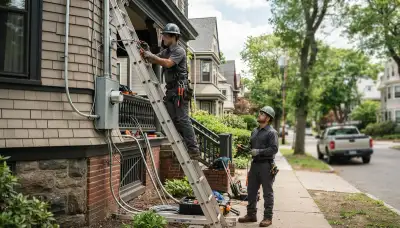
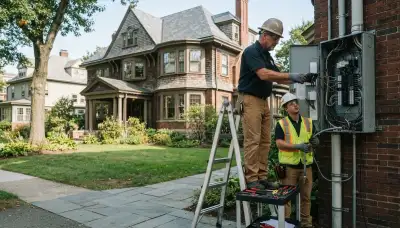
A local electrician working in Brookline knows that most panels here sit in a basement, that the wiring runs through plaster walls over wood framing, and that what looks like a simple outlet swap can involve knob-and-tube runs that need to be evaluated before anything is connected.
The two jobs that come up most often are panel replacements on homes that have outgrown their original capacity and grounding upgrades on circuits that were run before that was required. Homeowners in nearby Cambridge, MA electrical services deal with similar conditions in homes of the same age.
If an outlet is warm to the touch or a breaker trips every time two appliances run at once, getting an electrician in to look at it now costs far less than what it costs to wait.
Electrical Work Matched to How Brookline Homes Are Built
An off-the-shelf approach fails in Brookline because the homes here were built with plaster and lathe, not drywall, and running a new circuit without opening a ceiling or a wall takes planning that only comes from knowing these structures.
Detached homes on deeper lots often have outbuildings or garages with aging sub-panels and long outdoor runs that have corroded at the connections. Attached homes share walls that limit where conduit can travel, and a reliable outlet repair in one unit sometimes reveals wiring that crosses into a neighboring space.
Across Brookline, the work that fits these homes most often includes expert GFCI circuit installation, quality smoke detector installation, specialist electrical wiring work on plaster-wall runs, and professional home electrical inspection service to map what is actually inside these walls.
What the Age of Brookline Homes Still Decides Today
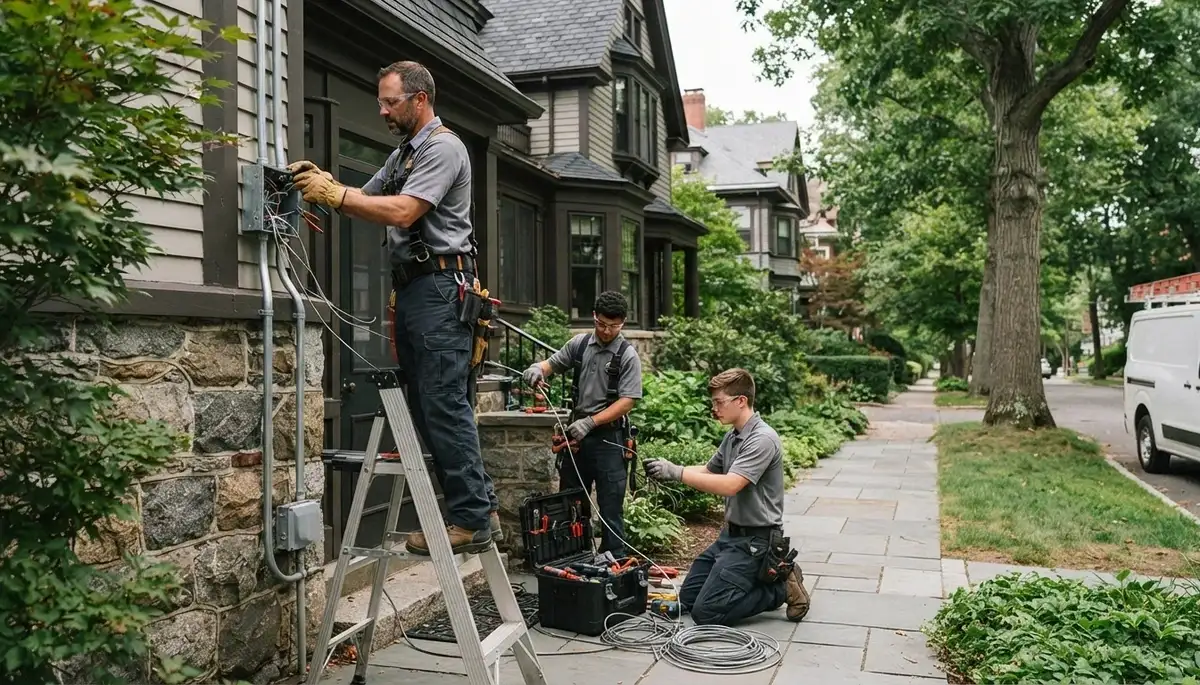
Most of the homes in Brookline went up from the early nineteen hundreds through the early nineteen sixties, a stretch when fuse boxes were standard, grounding was not required, and a household ran on a fraction of the circuits a kitchen alone needs now. Three things follow from that: the panels are undersized, the wiring is ungrounded, and the circuit count was never built for how these rooms are used today.
Fuses Instead of Breakers
A homeowner in a Brookline home built before the forties may still have a fuse box in the basement. When a fuse blows, it is easy to replace it with one rated higher than the wire it protects, which lets a circuit carry more current than the wiring can safely handle and creates a fire risk that builds silently inside the wall.
Local electricians replace fuse boxes with modern breaker panels sized for what the house actually runs now. Homeowners in Watertown, MA with homes of the same age face the same replacement need, and the correction is the same: a panel that matches the load.
Two-Prong Outlets Throughout the House
Two-prong outlets mean the circuits behind them were run without a ground wire. Plugging a three-prong adapter into an ungrounded outlet does not add protection - it only changes the shape of the opening. Sensitive electronics, appliances with metal housings, and anything in a kitchen or bathroom are all at greater risk when there is no path for a fault current to clear safely.
Grounding a circuit means running a new wire back to the panel or installing outlets with the test and reset buttons where a full rewire is not practical. Either way, the homeowner ends up with outlets that work the way the ones they are plugging into are supposed to work.
Circuits That Trip When Two Things Run
A kitchen in a Brookline home built in the fifties and sixties was often wired with one or two circuits feeding every outlet on the counter. A coffee maker and a toaster running at the same time trips the breaker because the circuit was never sized for that load. Extension cords used as permanent wiring are a sign the house has run out of places to plug things in.
Adding dedicated circuits to the kitchen, bathroom, and laundry areas stops the tripping and removes the extension cords. The homeowner can run what the room was built to hold without rationing outlets.
A Panel That Was Never Sized for What Was Added
A car charger, a window air conditioner, or a chest freezer in the basement each draws more current than the original panel was built to supply. When several of these loads run at once, the panel is carrying more than it was sized for, and a breaker that does not trip when it should is the part that makes that dangerous.
Upgrading to a higher-capacity panel gives the house room for the loads already on it and the ones a homeowner plans to add. After the upgrade, a car charger, a new air conditioning unit, and the rest of the house can all run without the panel being pushed past what it can safely handle.
Basement Panels Behind Finished Walls
In Brookline homes where a basement was finished at some point after the original build, the panel sometimes ended up behind a wall or inside a closet that was framed in around it. Reaching the panel to add a circuit or replace a breaker means working in a tight space, and running wire through finished ceilings adds time and cost that an open basement would not.
Local electricians who know these basements plan the work around what is already there, using existing chases and access points where they exist and opening only what has to be opened. The job gets done without tearing out more of the finished space than the work actually requires.
Call (617) 917-2122 to arrange a no-pressure visit from a local electrician who knows what these homes are carrying and can tell you what needs attention first.
On Call Electrical handles the work in Brookline homes the way it needs to be done - correctly the first time.

Full Electrical Services Available Across Brookline, MA
The list below covers the range of electrical work available to Brookline homeowners. Find what matches what you are seeing in your house and reach out to get it looked at.
Urgent Electrical Repairs in Brookline, MA
- Electrical Repair - a breaker that will not reset or an outlet that stopped working needs attention before the underlying cause gets worse.
- Outlet Repair - outlets that spark, feel warm, or have stopped holding a plug are a sign something behind the wall has failed.
- Switch Repair - a switch that buzzes, flickers, or does not respond reliably is more than an inconvenience in a home with older wiring.
- Ceiling Fan Repair - a fan that wobbles, hums, or runs only on one speed often has a wiring or connection problem at the box, not just a worn motor.
- Electrical Service - when the main service to the house is the problem, everything downstream is affected and the repair cannot wait.
If any of these match what you are seeing, a local electrician can tell you what is behind it and what it takes to fix it.
Panel, Capacity, and Wiring Work in Brookline, MA
- Electrical Panel Upgrade - homes built in the fifties and sixties were wired for a service level that does not cover what a household runs today.
- Electrical Panel Installation - replacing a fuse box or a panel that has reached the end of its useful life with one sized for the current load.
- Electrical Wiring - running new circuits through plaster walls and finished spaces requires planning that comes from knowing how these homes were built.
- New Construction Wiring - additions and accessory structures on Brookline properties need wiring that meets current requirements and connects cleanly to the existing service.
- Generator Installation - adding a standby generator to a home with an older panel requires a transfer switch and a service review before anything is connected.
Brookline homes built before the sixties rarely have the panel capacity or circuit count to handle what a household runs today without some of this work.
Safety and Protection Work in Brookline, MA
- GFCI Circuits - kitchens, bathrooms, and outdoor outlets in homes built before the eighties were not required to have the protection that stops a fault from reaching a person.
- GFC Outlets - installing the outlets with test and reset buttons at sinks and in wet areas is one of the most direct safety upgrades available in an older home.
- Smoke Detector Installation - detectors placed where the house was originally built, not where current requirements say they belong, leave parts of the home unprotected.
- Fire Alarm Installation - a connected system that covers the whole house gives a Brookline homeowner warning from any room, not just the one where a detector happens to be.
- Whole Home Surge Protection - a single surge from the street can damage every appliance and device connected to the panel; protection at the panel stops it before it reaches the circuits.
- Lightning Surge Protection - homes on lots with large trees or exposed rooflines carry more risk from a nearby strike reaching the service entrance.
These are the upgrades that protect what is already in the house and the people living in it. A home electrical inspection can identify which of them apply to your specific situation.
Lighting, Outdoor, and Added-Load Work in Brookline, MA
- Recessed Lighting Installation - adding recessed lights to a plaster ceiling in a Brookline home requires a plan for how the wire gets there without opening every bay.
- Landscape Lighting - outdoor lighting runs in Brookline yards age at the connections and at the fixtures, and a run that worked fine for years can develop faults that are hard to trace without the right equipment.
- Electric Car Charger Installation - a Level 2 charger draws more than most panels in older Brookline homes were built to supply, and the installation starts with a service review.
- Security Lights - motion-activated lights on detached garages and along long driveways require outdoor-rated wiring and a circuit that can carry the load without affecting the rest of the house.
- Ceiling Fan Installation - adding a ceiling fan to a room that was not wired for one means running a new circuit or confirming the existing box and wiring can carry the load safely.
These are the projects that come up as Brookline homeowners add to what their houses were originally built to do. A local electrician can tell you what the work involves before any of it starts.