Homes across Cambridge run on wiring and panels sized for a world without central air, car chargers, or a kitchen full of appliances. The electrical contractors in Boston behind this network handle the full picture: aging panels with no room left, outlets that were never grounded, and circuits that trip the moment two things run at once. A professional electrical panel upgrade starts with knowing what the house was built to carry.
Cambridge homeowners call a local electrician because these houses have specific histories, and a stranger to them wastes time and opens walls that did not need to be opened.
What Local Electricians Know About Cambridge Homes
A local electrician who has worked through Cambridge knows where the panel sits, what the original wiring looks like, and which rooms were added after the house was built. That knowledge changes how the work gets planned before anyone touches a wire.
Two kinds of work come up again and again in Cambridge homes: panels that have no empty slots and grounding that was never installed. Homeowners in nearby Somerville, MA electrical services deal with the same issues in houses built the same way.
If a breaker will not reset, an outlet feels warm, or lights dim when the refrigerator starts, get it looked at now before a small problem becomes a costly one.
Electrical Work Matched to How Cambridge Homes Are Built
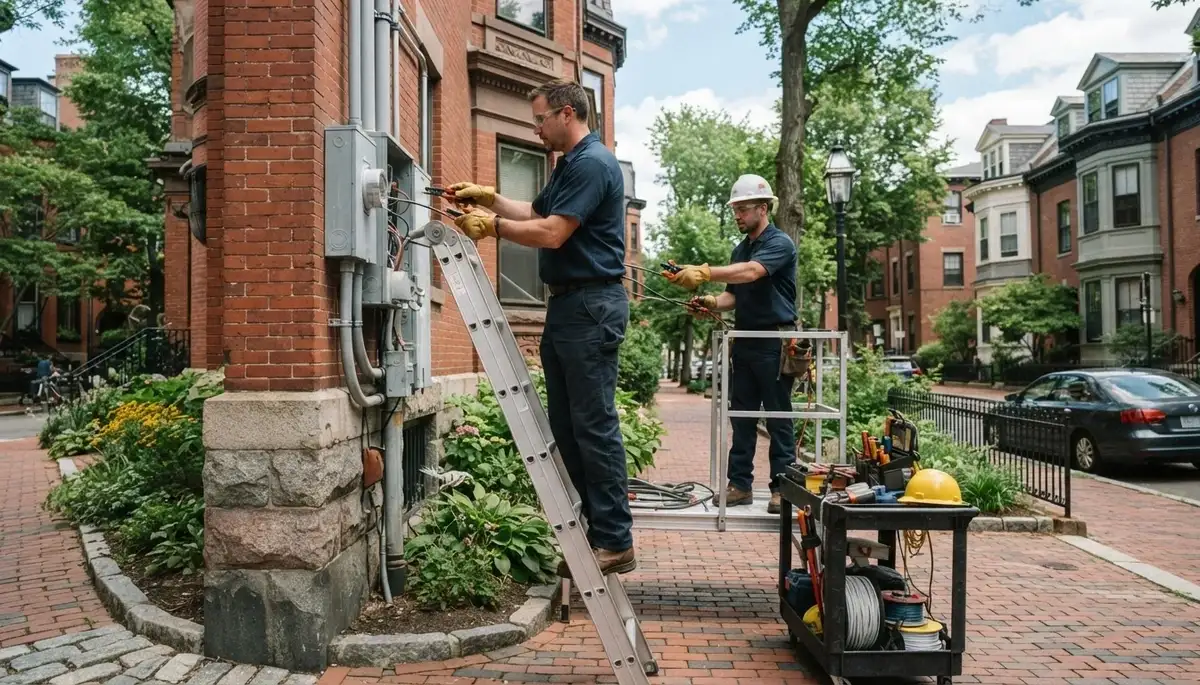
An off-the-shelf approach fails in Cambridge because the houses here are mostly attached, built close together, with panels in basements and wiring that runs through finished walls and shared party walls. Getting a new circuit to the right room is rarely a straight run.
Attached row houses mean shared walls that cannot be opened freely. Detached houses with deep basements give more access but longer runs to outbuildings. Either way, a reliable home electrical inspection tells the crew what they are walking into before the job starts.
Four services fit these homes well: expert electrical wiring for houses where the original runs are worn, quality GFCI circuit installation near every sink and bath, specialist generator installation for houses whose panels can support a standby unit, and professional electric car charger installation for garages and driveways that need a dedicated circuit.
When Cambridge Homes Were Built Still Shapes What They Need
Most homes in Cambridge went up in the decades before and just after the Second World War, with a strong wave continuing through the fifties and into the early sixties. Houses from those years came with 60-amp fused service, two-prong ungrounded outlets, and knob-and-tube or early plastic-sheathed wiring. Three things follow from that and still shape every job: the panel is almost certainly undersized, the grounding is missing or incomplete, and the circuit count was never built for how rooms are used now.
Fuses That Keep Blowing
A homeowner notices a fuse that blows every time the microwave and toaster run together. Behind it is a 60-amp service feeding a house that now pulls two to three times that load. Left alone, the fuse gets replaced with a larger one, which lets the wiring overheat without any protection.
Local electricians replace the fused service with a modern breaker panel sized for the actual load the house carries. Homeowners in Charlestown, MA with the same vintage houses go through the same upgrade.
Outlets with No Ground
Two-prong outlets throughout a house mean the wiring behind them was installed before grounding was required. Plugging in a surge protector or a computer does nothing to protect equipment when there is no ground path for a fault to follow.
Local electricians run a ground to each outlet or install GFCI protection where a ground wire cannot be added, bringing each location up to what the house should have had from the start.
Wiring That Has Reached Its Limit
Decades of use harden the insulation on older wiring until it cracks at connection points. A connection that once held tight now runs hot, and a warm outlet or a flickering light is the homeowner's first sign that something inside the wall is failing.
Replacing the connections and, where needed, the wiring itself stops the heat buildup and brings the circuit back to carrying its load without resistance.
A Panel That Was Never Sized for What Was Added
A car charger, a window air conditioner, and a new dishwasher each pull more than the original panel was sized to handle. On a hot afternoon when every appliance runs at once, the panel hits its limit and breakers trip in sequence.
Adding a subpanel or upgrading to a higher-capacity main panel gives the house room for every circuit it is running now and space for what gets added next, so the homeowner can run the car charger and the air conditioning at the same time without a second thought.
Basement Panels Behind Finished Walls
In many Cambridge homes the panel sits in a finished basement, and the path to upper-floor circuits runs through finished ceilings and party walls. That physical constraint turns a simple circuit addition into a job that requires careful planning to avoid opening surfaces unnecessarily.
Local electricians use existing chases, junction points, and access panels to route new circuits with minimal disruption, finishing the work without leaving the homeowner with walls to repair afterward.
Call (617) 917-2122 to arrange a no-pressure visit with a local electrician who can look at what the house has and tell the homeowner exactly what it needs.
On Call Electrical delivers work that holds in Cambridge homes, job after job.

Full Electrical Services Available in Cambridge, MA
The work below covers the full range of what Cambridge homeowners ask for. Find what fits the situation and call to get started.
Urgent Electrical Repairs in Cambridge, MA
- Electrical Repair: a breaker that will not reset or an outlet that stopped working in a house where the panel is already at capacity.
- Outlet Repair: an outlet warm to the touch or one that sparks when something is plugged in.
- Switch Repair: a switch that controls nothing or one that buzzes when the light is on.
- Electrical Panel Upgrade: a fuse box with no room left and a house that keeps tripping on the same circuit.
- Fire Alarm Installation: smoke detectors that are past their service life or missing from rooms that need them.
If the problem is happening now, call before it gets worse.
Panel, Service, and Wiring Work in Cambridge, MA
- Electrical Panel Installation: a full panel replacement in a house that still runs on original equipment from the fifties or sixties.
- Electrical Service: a service entrance that was sized for a much smaller load than the house carries today.
- Electrical Wiring: rewiring rooms where the original wiring has cracked insulation or undersized conductors.
- New Construction Wiring: wiring for an addition or a finished basement being brought into the main system.
- Home Energy Audit: a full review of how the house uses power and where the panel is being pushed hardest.
Upgrading the panel and the wiring behind it is what lets the rest of the electrical system do its job without overloading what was never built for today's load.
Safety and Protection Work in Cambridge, MA
- GFCI Circuits: protection near every sink, bath, and outdoor outlet where the original wiring left the homeowner exposed.
- GFC Outlets: individual outlet replacement in kitchens and bathrooms where a ground fault could reach water.
- Whole Home Surge Protection: a single device at the panel that stops a voltage spike from reaching every appliance in the house.
- Lightning Surge Protection: added protection for houses whose service entrance is exposed to the line.
- Smoke Detector Installation: interconnected detectors so an alarm in the basement wakes everyone on the upper floors.
Every one of these protects the homeowner from a risk that is easy to picture: a shock near the sink, a spike that kills the refrigerator, or a fire that starts in a room no one is in. Getting them in place is straightforward work that changes what the house can withstand.
Lighting, Outdoor, and Added-Load Work in Cambridge, MA
- Recessed Lighting Installation: new fixtures in rooms where the original overhead light was a single bulb on a ceiling box.
- Landscape Lighting: low-voltage outdoor lighting run from a dedicated circuit, not tapped off an existing one.
- Security Lights: motion-activated fixtures on the exterior of houses where the driveway or side yard is dark.
- Electric Car Charger Installation: a dedicated 240-volt circuit to the garage or driveway for a Level 2 charger.
- Ceiling Fan Installation: a fan-rated box and a dedicated switch in rooms where the original fixture box was not built to carry the load.
Each of these adds something the house was not originally built to carry. Getting the circuit right from the start means the addition runs without tripping anything else in the panel.