The network of electrical contractors in Boston that handles Charlestown homes works on houses where fuse boxes still occupy basement utility walls, two-prong outlets are the norm in older rooms, and professional electrical panel upgrade needs are as common as any other call. These are attached brick row houses and townhomes, mostly built before the 1940s, and the wiring inside them reflects every decade since.
That history is why homeowners here reach for a local electrician rather than a general one - someone who already knows what is behind the wall before the cover plate comes off.
What Local Electricians Know About Charlestown Homes
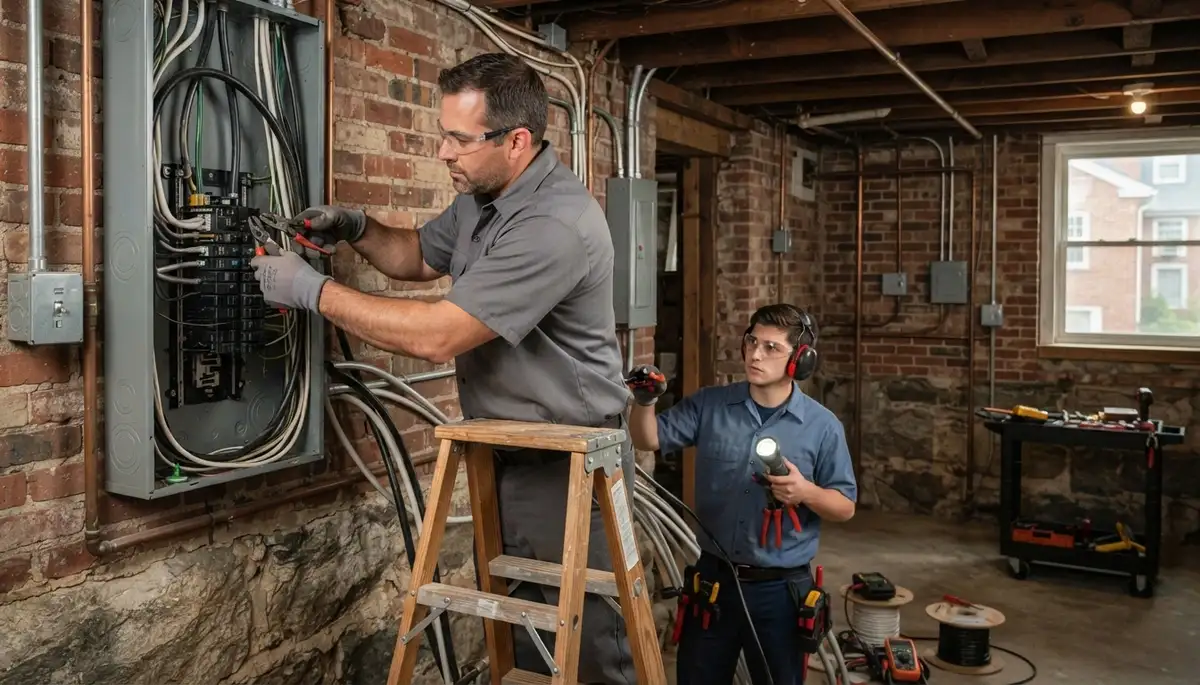
Charlestown homes are mostly attached brick row houses and townhomes built before the 1940s, with panels tucked into basement utility areas and wiring that has been patched and extended across many decades. A local electrician reads that layout before the first tool comes out.
Two kinds of work come up constantly in Charlestown: grounding upgrades in houses where two-prong outlets still line the walls, and panel replacements where a fuse box is still doing the job a breaker box should. Homeowners in nearby Chelsea, MA electrical services face similar calls on attached older homes.
If an outlet feels warm or a breaker will not reset, getting it looked at now costs far less than waiting for it to become something worse.
Work Matched to How Charlestown Homes Are Built
An off-the-shelf approach fails in attached row houses because the work cannot simply go through an attic or across an open crawlspace. Shared walls, brick construction, and basement-only panel access shape every job before the first measurement is taken.
Some homes here are freestanding brick structures with a full basement; others share walls on both sides, which limits where new circuits can run without opening finished surfaces. Both types change the scope of the job in ways that matter. Expert electrical wiring work in these homes requires planning the path before any wall is touched.
Four services fit these homes directly: quality home electrical inspection to map what is actually there, reliable GFCI circuit installation near every water source, specialist electrical panel installation where the fuse box still runs the house, and professional outlet repair where two-prong outlets remain on circuits that now carry modern loads.
How Charlestown Homes Built Before the 1940s Shape Electrical Work Today
Most homes in Charlestown went up before the 1940s, a period when wiring was sized for a handful of lights and a few wall outlets. Knob-and-tube wiring, fuse boxes, and two-prong ungrounded outlets were standard. Three things follow from that: no grounding path in most original circuits, no capacity for today's appliance loads, and no reset-button protection near sinks or tubs.
Outlets That Have No Ground
A homeowner notices two-prong outlets in older rooms and assumes they are simply outdated. Behind them is wiring that was installed without a ground wire, which means a fault has nowhere safe to go. Left alone, that gap raises the risk of shock and equipment damage on anything plugged in.
Local electricians run a ground wire to each circuit or replace the outlet with one that has test and reset buttons, restoring protection without opening every wall. Work across Charlestown follows the same approach that handles electrical repair in Somerville, MA on homes of the same age.
A Fuse Box That Has Run Out of Room
A homeowner sees a fuse box with every slot filled and a few fuses that have been replaced more than once. Behind it is a service that was sized for a fraction of what the house runs today. Adding any new circuit means doubling up, which is exactly how overloads start.
Replacing the fuse box with a modern breaker panel gives the house room to grow and eliminates the guesswork that comes every time a fuse blows. Breakers that trip can be reset; a pattern of trips points to the circuit that needs attention.
Wiring That Was Spliced and Extended Over Decades
Years of additions, finished basements, and updated kitchens left many Charlestown homes with wiring that was extended rather than replaced. Connections made decades apart, with different wire types joined together, lose their integrity over time and can no longer carry the load reliably.
Local electricians trace each circuit, identify the weak connections, and replace or re-run the affected runs. The two improvements that follow are a panel that no longer trips without explanation and outlets that stop running warm.
A Service Sized for a House That Did Not Have Central Air or a Car Charger
The original service in a Charlestown row house was sized for the loads of its era. Adding central air, an electric car charger, or a modern kitchen to that same service pushes the panel past what it was designed to handle, and heat from a heavy load on a summer afternoon only adds to the strain.
Adding capacity means bringing the service up to a level that handles what the house actually runs. Once that is done, a homeowner can run the air conditioning, charge the car, and use the kitchen at the same time without watching the panel.
Tight Access in an Attached Brick Home
Shared walls and brick construction mean there is often no clean path for a new circuit. Running wire through a finished room in an attached home without access from above or below can require opening walls and ceilings that the homeowner did not expect to touch.
Local electricians plan the route before any surface is opened, using the basement access and existing chases wherever possible. The goal is to get the circuit where it needs to go with the smallest footprint in finished space, so the homeowner is not left with a larger repair than the electrical job itself.
Arrange a no-pressure visit with a local electrician who knows these homes by calling (617) 917-2122. A look at the panel and the circuits costs nothing compared to what a missed problem becomes.
On Call Electrical handles Charlestown homes with work that holds the first time.

Full Electrical Services Available in Charlestown, MA
The work below covers the range of what local electricians handle in Charlestown homes. Find what matches your situation and call to set up a visit.
Urgent Electrical Work for Charlestown, MA Homes
- Electrical Repair - A breaker that will not reset or an outlet that stopped working in an older row house needs a look before it becomes a hazard.
- Outlet Repair - Warm outlets or ones that stopped holding a plug are common in homes where the original wiring has been in service for decades.
- Switch Repair - A switch that sparks, feels loose, or controls nothing anymore is worth fixing before it becomes a wiring problem.
- Smoke Detector Installation - Older homes without interconnected detectors on every level leave the household without enough warning time.
- Fire Alarm Installation - Attached homes where a fire can move through shared walls need detection that responds before smoke reaches the stairs.
Any of these showing up in your home is a reason to call, not a reason to wait.
Capacity and Wiring Work for Charlestown, MA Homes
- Electrical Panel Upgrade - A fuse box or a panel with no room left was sized for a house that did not run what yours runs today.
- Electrical Panel Installation - Replacing a fuse box with a modern breaker panel gives the house room for every circuit it needs.
- Electrical Service - Bringing the service entry up to current capacity is what makes everything downstream work without strain.
- Electrical Wiring - Spliced and extended runs from multiple decades need to be traced and replaced where they can no longer carry the load.
- New Construction Wiring - Additions and finished basements in Charlestown homes need wiring that meets current requirements, not extensions of what was already there.
Homes built before the 1940s were wired for a fraction of what a modern household runs; bringing the capacity up is the fix that makes every other upgrade work.
Safety and Protection Work for Charlestown, MA Homes
- GFCI Circuits - Kitchens, bathrooms, and finished basements in older homes need the outlets with test and reset buttons on every circuit near water.
- GFC Outlets - Individual outlet replacement with ground-fault protection covers the spots where a full circuit upgrade is not yet in scope.
- Whole Home Surge Protection - A single surge can damage every appliance and device in the house; protection at the panel stops it before it reaches anything.
- Lightning Surge Protection - Homes in dense attached rows share exposure; a direct or nearby strike sends voltage through the wiring that surge protection at the panel absorbs.
- Home Electrical Inspections - A full inspection of a Charlestown home maps what is original, what has been extended, and what needs attention before it causes a problem.
These are the protections that keep a home from becoming a statistic. An older house with original wiring and no surge protection is carrying more risk than most homeowners realize, and a single inspection is enough to know exactly where that risk sits and what it takes to close it.
Lighting, Outdoor, and Added-Load Work for Charlestown, MA Homes
- Recessed Lighting Installation - Finished rooms in Charlestown townhomes that still run surface fixtures can be updated without opening the ceiling if the attic or floor above allows access.
- Electric Car Charger Installation - A dedicated circuit for a car charger is one of the most common added loads in Charlestown, and the original service in most homes was not sized for it.
- Security Lights - Exterior lighting on a narrow lot or a shared driveway needs its own circuit so it does not pull from what the interior already runs.
- Landscape Lighting - Low-voltage outdoor runs on a small Charlestown lot still need a proper connection at the panel to avoid overloading an existing circuit.
- Generator Installation - An attached home with no backup power goes dark when the grid goes down; a generator connection at the panel keeps the essentials running.
Charlestown homes are being asked to carry loads they were never designed for, and the right electrical work is what makes that possible without risk to the house or the people in it.